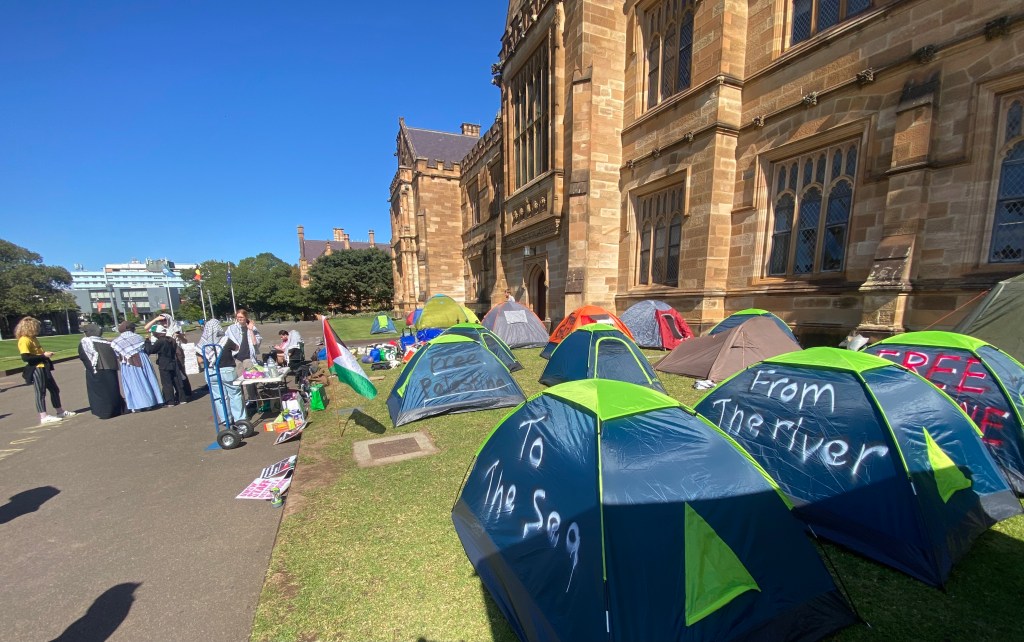
After two years of student protests in university campuses throughout Europe (and beyond) it is fair to ask what the role of the teachers, researchers and professors should be towards them. Joining them means, in this case, to use their knowledge at their service, to provide the tools able to expose the ideological contradictions of critical education and their colonial features.
This conclusion is not new. I recently re-read the texts ‘A plea for intellectuals’ and ‘a friend of the people’, which together form a series of lectures and interviews done by Jean Paul Sartre between 1965 and 1970. At that time, students were also protesting in their campuses. The teachers found themselves in a similar position. The Vietnam war was exposing the imperialist nature of mainstream politics, and its ideology that was inculcated in the myriads of lectures within the campuses. It is fair to say that today’s critique of higher education relations with Israeli institutions shows some basic resemblances to those times.
In those lectures Sartre spends a great deal of time in defining what is actually an intellectual, or a public intellectual. I try to summarize here in simple terms his philosophical jargon. The basic idea is that an intellectual ‘is someone who meddles in what is not his business and claims to question both received truths and the accepted behavior inspired by them’. He distinguishes intellectuals from scientists. The scientist is the ‘technician’ of knowledge, which for Sartre is always ‘practical’ because it is creative. Yet, the scientist does not step out of its own field of expertise, nor gives claims beyond its field.
Sartre makes it clear that the intellectual is always owner of a certain specific knowledge, so it is very often a scientist, which is indeed a ‘technician of knowledge’. The interesting aspect of his definition lies in his understanding of how scientists are created in capitalist society. Scientists are the product of the ideological apparatus of capitalism. They are educated in the headquarters of capital, the universities, where only if you pay 20k you can get a degree. Even when working class students get to join these programs, they get to internalize the dominant ideology. Ideology is transferred in the university by and through scientists.
The intellectual of Sartre is what he defined ‘uncomfortably conscious’ scientist. The intellectual is aware of its condition. They are in a constant frustration because they know that they internalize this fundamental contradiction: they are the workers of ideology as well as the researchers, they have been trained within the colonialist and capitalist relations of knowledge production to actually critique them. This unease of the scientist, Sartre says, can be resolved only when the scientist becomes an intellectual.
The transformation of a scientist into an intellectual, Sartre argues, occurs when the intellectual critiques their own identity as such. When it critiques the institutions that have produced scientists. In his words ‘The intellectual is thus someone who becomes aware of the opposition, both within himself (sic) and within society, between a search for practical truth (with all the norms that it implies) and a ruling ideology’.
For Sartre, the intellectual needs to perform and internalize this struggle. The way to do so is to redirect the struggle towards its own institution itself, the which has made them as such. The first field of intellectual struggle and critique must be the way universities work, the place where the technicians of knowledge are produced.
Here it is interesting to see how Sartre distinguish the true ‘public intellectual’ from the ‘false intellectual’ and the ‘classic intellectual’. The false intellectual is the one that, while talking about things that are beyond their scope of expertise, does so in a general manner, without recognizing the particularity of a situation. False intellectual call for generalist statements like ‘talking is always good’, ‘occupations are never good’, ‘there is a limit to this or that anger’, etc. Sartre recognizes that these statements are applying some general values to specific situations. This is for him the moment in which scientists even end up being scientists, since practical knowledge is always situated. These false intellectuals seem to raise their critique to the system but by keeping at the level of generality they are not doing anything ‘useful’ (see below). Interestingly, Sartre also says that these false intellectuals are ‘radicalizing’ the true intellectual.
The classic intellectual of Sartre is also an interesting profile. These are the ‘critical scholars’ that are joining marches, signing petitions, writing papers against, for example, fossil capitalism, settler colonialism or green capitalism. They are fully aware of how bad the system is and they do want to help changing it. Yet, they are classic because they are not ‘actively using’ their knowledge to help movements and the masses rising. For Sartre, knowledge is always practical, and the practical is always situation specific, which means that it is always ‘used’. Explaining colonialism is not enough to turn it practical for the movements and the students. For Sartre, the classic intellectual ends up being ‘conservative’ because of its ‘ideological interest’: the interest in making sure that the ‘truth’ that they have studied and published for years in their books remains a truth. He looks at himself as an example of this, having written many books.
Sartre concludes: “what an intellectual should learn to do is to put what he has been able to salvage from the disciplines that taught him universal techniques, directly at the service of the masses. Intellectuals must learn to understand the universal that masses want in the immediate, this very moment”. This is the call for putting minds and bodies next to movements and helping the movements through knowledge. This is why, I think, public intellectuals, or true intellectuals, join these protests.
Federico
 Planetary Crises, Amateurish Actions